
Water system managers and engineering teams face increasing pressure from rising demands, climate pressures, aging infrastructure, changing regulatory requirements, budget constraints, and growing expectations for system resilience.
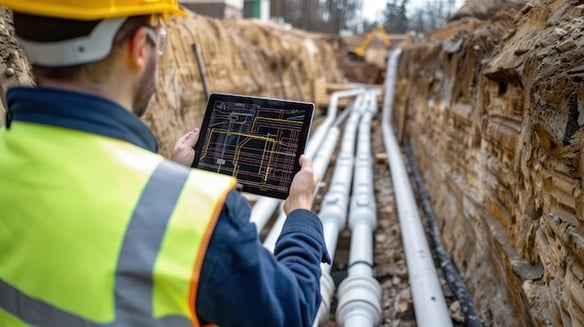
Image source: Phoophinvo/stock.adobe.com.
What You'll Learn
|
To address these challenges, artificial intelligence (AI) is emerging as a practical tool to augment engineering workflows — helping teams identify patterns in large datasets, forecast system behavior, and automate time-consuming analysis tasks. For example, AI can analyze pipe inspection video to identify defects more quickly or accelerate stormwater modeling to help engineers evaluate risk and design more resilient systems.
When integrated with other digital technologies, AI can aid decision-making and improve planning and productivity. Autodesk water infrastructure solutions are increasingly incorporating AI-enabled capabilities that support these workflows across planning, design, modeling, and asset management. This e-book explores how AI is transforming water infrastructure workflows, where Autodesk water solutions apply these capabilities today, and how utilities and engineering teams can take advantage of them.
Challenges Confronting Modern Water Systems
Many of the challenges in modern water system management stem from basic supply and demand pressures. Growing population and urbanization are increasing water demand, often outpacing available supplies. At the same time, changing weather patterns are contributing to more frequent droughts in some areas and flooding in others.
Meanwhile, water infrastructure is aging. Many water utilities rely on decades-old infrastructure, with systems reaching or exceeding their intended service life, leading to water loss due to leakage, reduced pressures and flows for normal and emergency operations, and increasing maintenance costs. In its 2025 Infrastructure Report Card for America, the American Society of Civil Engineers (ASCE) gave America’s infrastructure a grade of C, with the three main water categories — drinking water, wastewater, and stormwater — showing no improvement in recent years.
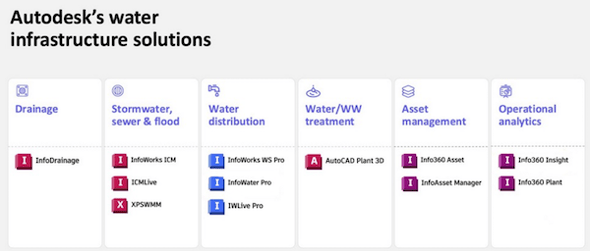
Autodesk water infrastructure products provide a wide range of water-related solutions. Image source: ARKANCE.
Addressing these issues is often difficult and constrained by limited funding. Water management involves complex networks of pipelines, pumps, storage reservoirs, and treatment facilities that must operate continuously. Utilities must manage water quality, distribution, wastewater, and stormwater simultaneously. Engineers must coordinate planning, design, operations, and maintenance for systems that are often overloaded and in need of upgrades.
Water utilities must also manage massive volumes of operational and environmental data. Sources such as supervisory control and data acquisition (SCADA) systems, IoT sensors, hydraulic models, GIS platforms, asset management systems, and video-based inspection technologies generate large datasets that can overwhelm traditional analytical tools and limit the ability to fully leverage this information. As data volumes grow, utilities often struggle to analyze information quickly enough to support proactive decision-making, risk assessment, and long-term infrastructure planning.
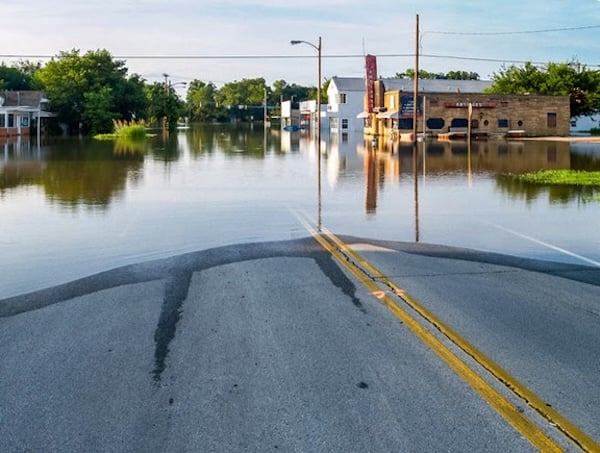
Using smarter hydraulic simulations and predictive management methods can help mitigate floods. Image source: ARKANCE.
How Does AI Improve Flood Modeling and Stormwater Design?
The challenges of water system management are accelerating the adoption of digital platforms that combine hydraulic modeling, operational data analysis, and asset management to support better planning and decision-making. While many of these tools have been available for years, recent advancements in AI technologies are expanding the capabilities of digital tools.
AI-assisted infrastructure workflows use machine learning and advanced analytics to process large datasets and generate insights. For example, machine learning tools can analyze pipe inspection video to identify defects more efficiently. Similarly, AI can accelerate flood and stormwater modeling to help engineers evaluate risk and design more resilient systems. These capabilities are not intended to replace engineers, but augment engineering expertise by helping detect patterns, forecast outcomes, and automate routine tasks.
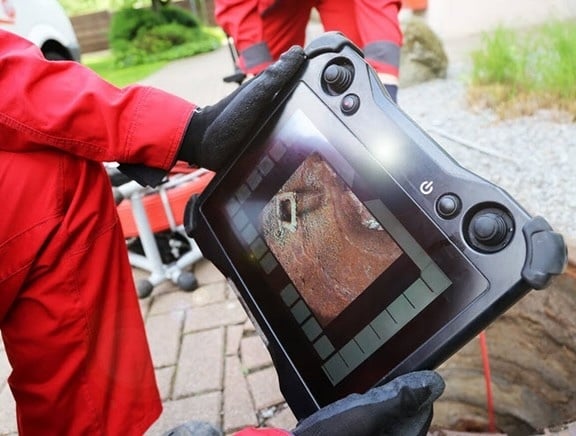
Real-time data can be obtained with digital technology and used to perform predictive analytics, leading to more proactive decisions and maintenance. Image source: ARKANCE.
When integrated with digital water infrastructure technology, AI dramatically expands the landscape of design and analysis methodologies. Autodesk’s InfoDrainage, for example, includes the AI-based Machine Learning Deluge tool, which enables engineers to predict flooding quickly and accurately simulating water flow across a site surface. Other hydraulic tools, such as InfoWater Pro for modeling water distribution systems and InfoWorks ICM for modeling sanitary and storm sewer systems, provide advanced modeling capabilities that can be enhanced by AI-driven analysis.
With the massive amounts of data generated by digital technology, AI can play a key role in managing that data. Large datasets such as point cloud LiDAR survey files can take weeks for design teams to analyze and process, while AI can reduce this process to hours or minutes, freeing designers to focus on more creative tasks.
The growth of cloud computing is enabling infrastructure teams to leverage AI technology and tackle increasingly complex problems. By housing data in a central location, multi-discipline teams can access data from multiple locations and perform a variety of design and analysis functions. With expanded capabilities to store and process large datasets, cloud computing forms the foundation required for many AI-driven workflows in data-intensive areas such as water consumption, water quality, system performance, and infrastructure maintenance.
Applying AI in Water Management
Applications for AI in water management are expanding across areas such as flood modeling, demand forecasting, system modeling, and asset management. For stormwater modeling and flood prediction, the AI-based Machine Learning Deluge tool in InfoDrainage can quickly analyze multiple flood simulations and site conditions to guide drainage design decisions. By modeling surface flows and ponding, InfoDrainage highlights where flooding is most likely to occur and where stormwater controls will have the most impact.
In comparison to traditional methods, the machine learning tools in InfoDrainage can enable more detailed analysis of larger catchment areas, incorporate historical flood patterns and weather data, and improve flood prediction and design optimization. The tool enables iterative, interactive and real-time modification, allowing users to revise design features and get instant feedback on the flooding conditions to optimize designs.
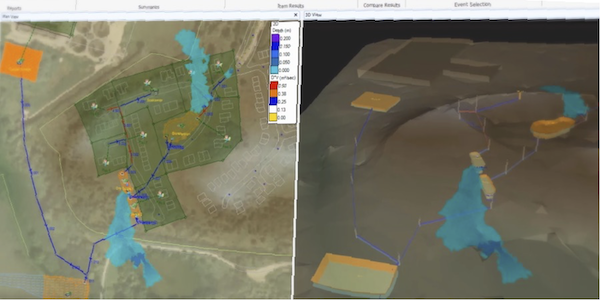
The AI-based Machine Learning Deluge tool in InfoDrainage can quickly analyze multiple flood simulations and site conditions to highlight where flooding is most likely to occur and where stormwater controls will have the most impact. Image source: Autodesk.
InfoDrainage can also work with tools such as Autodesk XPSWMM, which is used to simulate stormwater, wastewater, and combined sewer flows. For example, teams can model rainfall runoff scenarios in urban watersheds to identify potential sewer system overflows and mitigate impacts of those overflows on water quality.
For water demand forecasting, InfoWater Pro and InfoWorks ICM allow engineers to simulate distribution and wastewater networks, evaluate demand scenarios, and analyze system performance under different operating conditions. AI and advanced analytics can complement these models by identifying consumption patterns, forecasting demand trends, and helping utilities optimize system operations.
In addition to modeling physical system characteristics such as pipe size and materials, these tools can incorporate telemetry data to analyze system performance during high demand, firefighting events, and fluctuating supply conditions. It can also analyze the movement and concentration of interacting chemicals in water flows and model water age to optimize water quality.
InfoWorks ICM provides tools for modeling hydraulic and hydrologic network elements in a collaborative environment. Using InfoWorks ICM Sewer, engineers can perform sewer-specific modeling in the cloud or locally to model system behavior and plan for system improvements.
For management of infrastructure assets, Autodesk Info360 Asset supports asset management and risk-based planning. When paired with VAPAR AI inspection analysis, it can guide predictive maintenance workflows. AI-powered inspection tools reduce the time required to review inspection footage and help utilities develop more accurate rehabilitation and capital planning strategies. The AI tools identify and classify pipe defects, flagging problems in seconds, rather than countless hours of manual inspection review.
Related tools such as Civil 3D support infrastructure workflows with AI-assisted features, including Autodesk Assistant, which uses agentic AI technology to generate responses to user questions. When integrated with digital twin workflows in tools such as Civil 3D and Revit, water system managers can access system information in real time, aiding planning, design, construction, operations and maintenance activities.
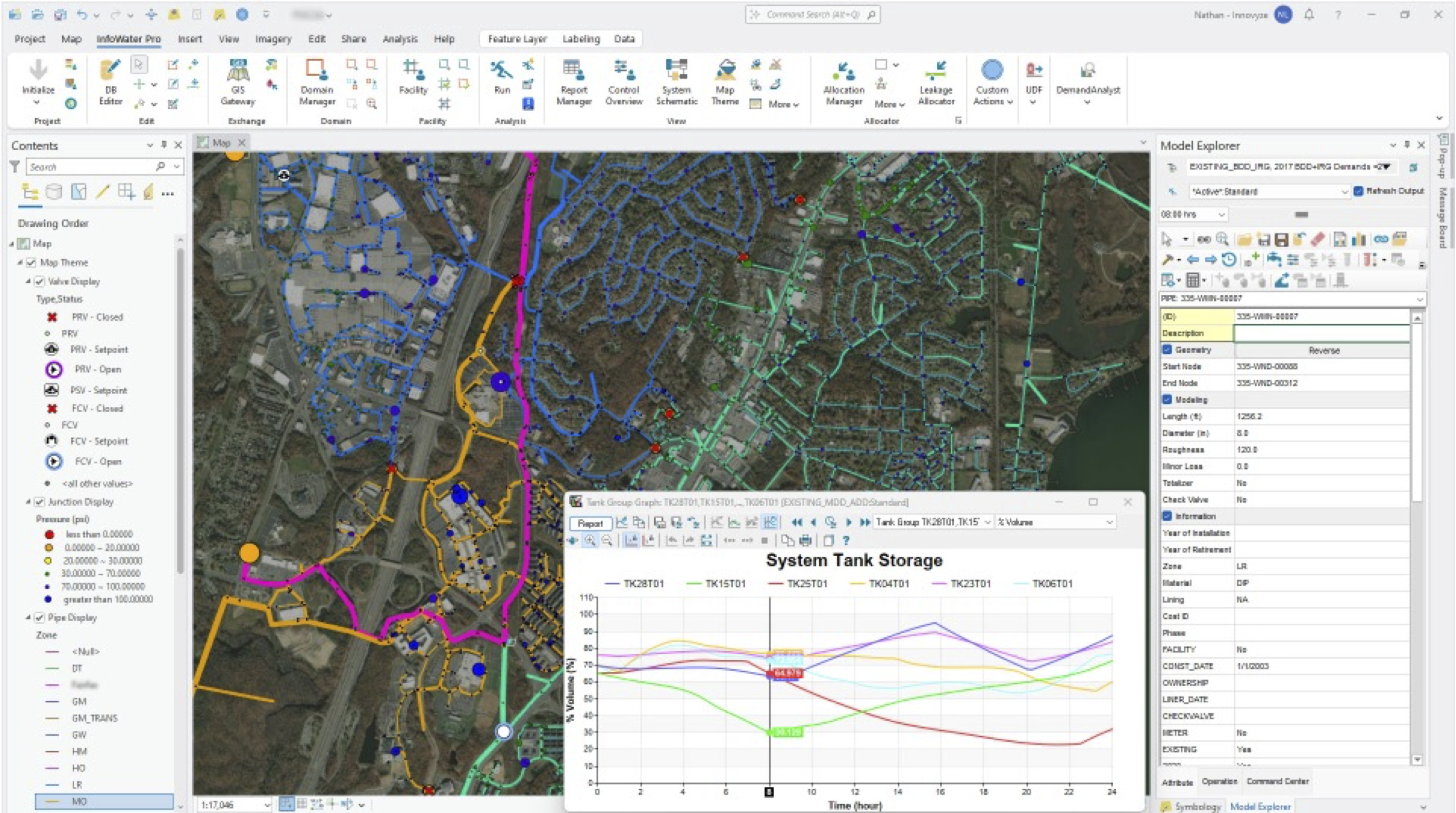
InfoWater Pro aids analysis of system performance under various operation conditions. Image source: Autodesk.
What Are the Biggest Challenges in Adopting AI?
While AI offers significant capabilities to infrastructure professionals, it also presents several challenges. To be effective, AI requires high-quality data, a skilled workforce, smooth integration with legacy systems, and sound, ethical practices in infrastructure-related industries.
A thorough review of data quality is a critical first step in obtaining meaningful AI results. Data often comes from multiple disconnected sources — such as GIS, SCADA, and modeling systems — making it difficult to consolidate for analysis.
The large datasets require adequate computing resources for efficient processing. Cloud computing can help support these demands, enabling AI-driven workflows to be handled offsite, freeing local resources.
Implementation of AI also requires a workforce with the appropriate skills. This might require a shift for many AECO organizations, as they hire and train personnel who understand AI, rather than treating AI as a “black box” that simply generates answers.
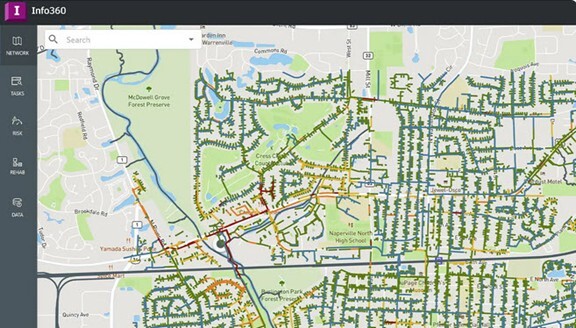
The integration of Info360 Asset with VAPAR AI streamlines pipe inspection. Image source: ARKANCE.
Organizations may also need to adapt workflows to incorporate AI-assisted analysis. This can include updating processes to support data collection, integration, and evaluation, as well as ensuring compatibility with legacy systems, such as CAD, GIS, hydraulic modeling, and project management tools.
AI also raises new ethical and governance questions, such as: What is the origin and reliability of the input data? Who owns the data? And who owns the results of AI-generated output? Organizations must also ensure that proprietary data is handled appropriately, particularly when using public AI tools.

Water professionals using Autodesk AI-enhanced workflows are well equipped to build resilient infrastructure. Image source: ARKANCE.
How ARKANCE Can Help
While AI adoption might seem daunting, the challenges can be readily addressed with the right strategy and resources. A technology partner such as ARKANCE can help organizations develop digital strategies, evaluate workflows, and identify opportunities to incorporate AI-driven technologies. ARKANCE works with infrastructure agencies and their private-sector partners to provide support across initial planning, deployment, training, and ongoing operations.
With decades of experience in Autodesk infrastructure technology, ARKANCE can help incorporate Autodesk water solutions into current workflows. This includes modernizing workflows to take advantage of AI-enabled capabilities within Autodesk water solutions. ARKANCE can tailor training and workforce development to meet organizational needs, while also supporting customization and ongoing innovation. By helping organizations improve data management, integrate systems, and modernize workflows, ARKANCE enables utilities and engineering teams to take full advantage of emerging AI capabilities.
What’s Ahead?
The use of AI in water resources is still evolving. Beyond managing and analyzing large datasets, additional developments are emerging with generative design, which enables designers to input key parameters and generate multiple design alternatives. This could transform the design of complex projects, such as wastewater treatment plants, automating aspects of design and producing more efficient, resilient outcomes.
AI-aided inspection processes are also continuing to evolve. In addition to pipeline inspection, AI is being used in the inspection of bridges, roads, mechanical equipment, and infrastructure assets.
Deeper integration of digital twins and building information modeling (BIM) is providing new tools for infrastructure management. As teams augment 3D models with data such as part numbers, specifications, and other BIM information, models are becoming more intelligent. When digital twins — digital replicas of infrastructure systems — are used in conjunction with AI technology, owners and support teams can proactively monitor systems and make real-time updates that guide operations and maintenance (O&M). In water infrastructure, this can make more meaningful use of real-time IoT sensor data, such as pressure and flow information in a water distribution system, to guide key decisions, such as when to upgrade and maintain pumps and other components.
While AI technologies will continue to expand, the expertise of water engineers and infrastructure professionals will remain essential for interpreting results, validating models, and making responsible decisions about critical infrastructure systems. As water becomes an increasingly precious commodity, both AI and human expertise are needed to safeguard water resources.
With continued investment and technological innovation, AI will help utilities move toward smarter, more resilient, and sustainable systems. Partners such as ARKANCE help utilities and engineering organizations implement these technologies effectively, enabling teams to take full advantage of AI-enabled water infrastructure solutions. υ
New Approaches to Water Infrastructure Management with AI FAQWhat is AI in water infrastructure management?AI in water infrastructure management uses machine learning and advanced analytics to help utilities and engineers analyze large datasets, identify patterns, predict system behavior, and automate time-consuming tasks. In practice, it can support workflows such as flood modeling, demand forecasting, pipe inspection analysis, and asset management.
How does AI improve flood modeling and stormwater design?AI can accelerate flood and stormwater analysis by processing multiple simulations and site conditions faster than traditional manual workflows. This helps engineers identify where flooding is most likely to occur, compare design alternatives, and optimize drainage strategies earlier in the design process.
How is AI used in pipe inspection and asset management?AI-powered inspection tools can review pipe inspection video, identify defects, and classify issues in far less time than manual review. When connected to asset management platforms, these insights can support predictive maintenance, rehabilitation planning, and risk-based capital improvement decisions.
Can AI replace hydraulic modeling software?No. AI does not replace hydraulic modeling software or engineering judgment. Instead, it enhances modeling workflows by helping teams process more data, evaluate scenarios faster, and uncover patterns that might otherwise be missed. Engineers still need to validate results and make final decisions.
What data sources support AI in water system workflows?AI in water workflows can draw from SCADA systems, IoT sensors, hydraulic models, GIS platforms, asset management systems, inspection video, and other sources. The value of AI depends heavily on data quality, consistency, and how well these sources are integrated across teams and systems.
What are the biggest challenges to adopting AI in water infrastructure?Common challenges include fragmented data, limited computing resources, integration with legacy systems, workforce training needs, and governance concerns such as data ownership, transparency, and responsible use. Successful adoption usually requires both technology investment and process change. |
***
This article was sponsored by ARKANCE.
Download this article as an eBook today!




Searching for more information about Architecture, Infrastructure, and Construction?
Click here!