
Image source: Kunwer Studio/stock.adobe.com.
|
As AI moves from isolated task assistance to connected, agentic workflows, AEC firms are rethinking the workstation’s role in design, analysis, and project delivery. This article explores how local AI infrastructure, Lenovo workstations, and NVIDIA technologies can help firms run AI-enabled workflows securely and efficiently within their own environments. |
To meet ever-growing demands of complex infrastructure and building-related projects, AEC firms are always searching for new tools to complete work faster, more efficiently, and with greater precision. Many firms have implemented AI to assist with labor-intensive tasks, such as analyzing lengthy documents and large datasets. A growing number of firms are moving beyond AI assistance toward AI-automated workflows featuring agentic AI — which features AI agents that act and make decisions much like a human might, while under a designer’s control. That transition enables firms to achieve more connected workflows that coordinate multiple applications, automate repetitive tasks, and accelerate project delivery.
The transition to AI-automated workflows also changes computing infrastructure requirements, workstation strategy, governance expectations, and developer priorities. Agentic AI and automated workflows require AI-ready workstations and local infrastructure capable of running compute-intensive, graphics-rich applications and local AI models simultaneously. Technologies such as those from Lenovo and NVIDIA can provide the computing foundation needed to support these emerging AI-enabled workflows securely and efficiently inside modern AEC environments.
In this article, you'll learn:
|
|
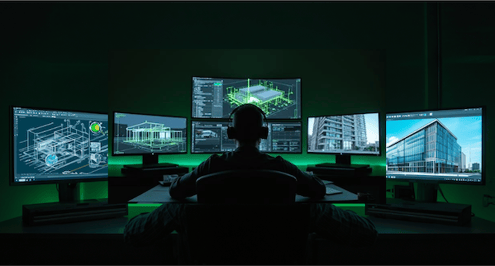
Using agentic AI, firms can achieve more connected workflows that coordinate multiple applications, automate repetitive tasks, and accelerate project delivery. Design generated using Canva Magic Design.
Why Are AEC Firms Moving from AI Assistance to Agentic AI Workflows?
While early implementations of AI have helped AEC firms accomplish specific tasks faster, firms can reap even bigger benefits by moving from isolated assistance tools into connected workflows that dramatically improve project outcomes. Agentic AI workflows can help firms handle increasing project complexity driven by technology such as robotic manufacturing facilities, massive data centers, and large, heavily regulated infrastructure projects. These new capabilities can also help firms meet rising performance expectations from clients demanding faster project delivery, more design alternatives, greater coordination across teams, and deeper insight into project status across project lifecycles.
Modern AEC workflows already involve multiple applications for different stages of design and construction, such as CAD, BIM, digital twins, visualization, project controls, and various types of analysis. Many of these analyses and simulations — in areas such as structural, mechanical, and hydraulic engineering — use complex techniques such as finite element analysis (FEA). While firms often have rich expertise in many of these areas, they often lack streamlined workflows with sustainable operational approaches that tie various applications together.
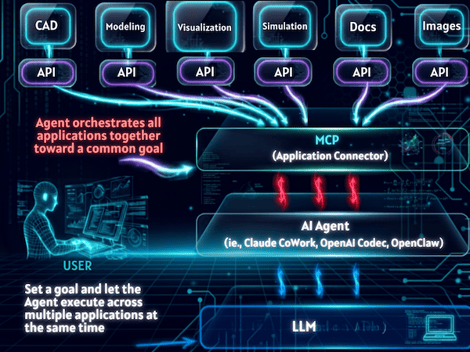
Agentic AI orchestrates multiple applications to achieve a common goal. Image concept: NVIDIA. Design generated using Canva Magic Design.
Key Terms for AI |
|
Agentic AI: AI systems that can plan, take actions, and coordinate tools to achieve goals with limited human intervention. AI Inference: The process of running a trained AI model to generate predictions or outputs. Model Context Protocol (MCP): An open standard that allows AI systems to connect with software applications, APIs, and data sources. OpenUSD: A framework for exchanging and coordinating 3D data across applications. RAG (Retrieval-Augmented Generation): A technique that grounds AI responses in trusted external data. |
Streamlining Fragmented Workflows
Agentic AI can help streamline fragmented workflows, connecting multiple models and tools and supporting increasing amounts of project data, coordination, and analysis. Agentic AI builds on the capabilities of generative AI — which creates and analyzes content, such as text, images, video, and code, based on large language models (LLMs). While generative AI enables users to communicate with applications using common language interaction, agentic AI employs an agent to take action with minimal human intervention.
Taking this a step further, agentic AI can communicate between LLMs and model context protocol (MCP) in connecting multiple tools and workflows. This allows AI systems to coordinate tasks across applications — such as CAD, BIM, conceptual modeling, analysis, and documentation applications — simultaneously rather than requiring teams to manually move information between disconnected tools. As Alfonso Oliva, leader of Developer Relations for the AEC industry at NVIDIA, explains, “AI basically is moving from assistance to orchestration.”
MCP, developed by Anthropic, is an open-source standard that acts as a universal adapter for AI systems, playing a key role in agentic AI. It helps standardize how AI agents interact with tools and APIs, reducing integration complexity rather than eliminating it. MCP understands application programming interfaces (APIs) of different applications, so it can communicate tasks and functions with each application.
The agent provides the intelligence to coordinate tasks between applications and support more connected project workflows. With AI agents running on LLM platforms, AEC professionals can provide general goals and rely on the agent to execute across multiple applications to achieve a stated goal.
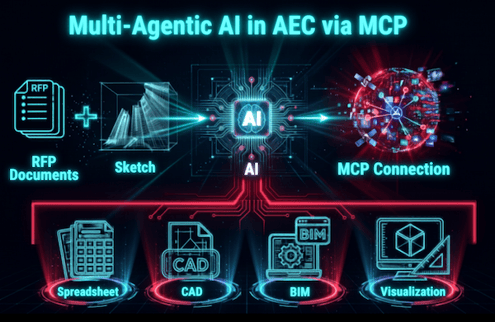
Multi-agentic AI can leverage multiple applications to advance a project from RFP stage to final design. Image concept: NVIDIA. Design generated using Canva Magic Design.
How Does AI Deliver Value Across the AEC Project Lifecycle?
AI is no longer just an experimental curiosity for AEC firms; it’s becoming part of daily workflows. AI has helped firms accelerate analysis, improve decision-making, automate repetitive tasks, and coordinate work across project teams. Graphics-intensive workflows such as reality-capture, LiDAR scanning, photogrammetry, drone imagery, and digital twins have also benefited from AI-driven tools.
As AI gains familiarity in AEC environments, it can also help accelerate workflows and provide benefits across project lifecycles. For example, AI-assisted building information modeling (BIM) can help streamline BIM and digital twin development during design, and provide additional post-design benefits, such as construction sequencing, predictive maintenance, and intelligent site operations.
Construction robotics offers additional potential applications, as AI-driven tools handle repetitive and potentially dangerous tasks. Edge AI, which deploys AI in close proximity to local edge devices, such as sensors or Internet of Things (IoT) devices, can manage large complex datasets in areas such as traffic engineering and building management.
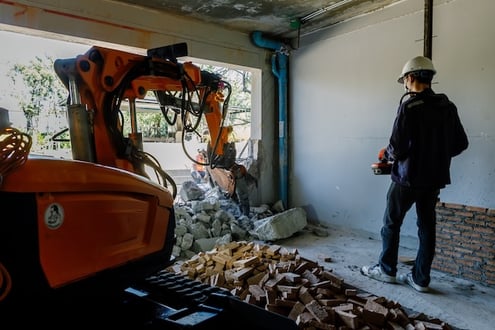
Robots used for construction can make a workspace safer. Image source: Ekkasit A Siam/stock.adobe.com.
How Do AI Agents Coordinate Design and Engineering Workflows? |
|
Natural Progression of Agentic AI
With tangible benefits achieved from generative AI, agentic AI is a natural progression for AEC firms seeking more connected workflows. The ability to rely on AI to coordinate multiple applications to achieve a stated goal can dramatically improve project efficiency. And, deploying multi-agentic AI opens offers even more possibilities for involving AI throughout project lifecycles. In an example scenario, AI can analyze an initial request for proposals (RFP) for a building project, along with a simple design sketch, then progress the design through conceptual and final design, using multiple tools and data sources, all under a designer’s control.
The orchestration of multiple graphics-intensive apps requires significantly more local computing resources than traditional workflows. Instead of handling data and processes from one application, workstations need to handle multiple applications simultaneously.
In addition to employing multiple applications, most AEC firms want to maintain control of their intellectual property, project data, and AI workflows. This creates a strong case for AI-ready workstations and local infrastructure capable of supporting secure, high-performance AI workflows in the AEC environment.
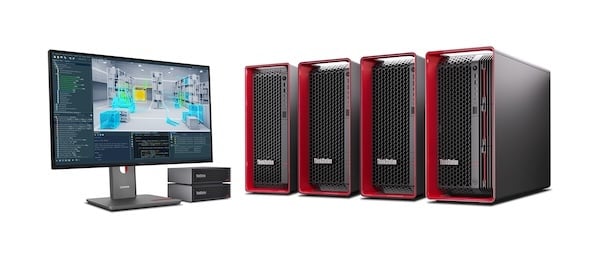
Lenovo’s ThinkStation P family of workstations fitted with NVIDIA GPUs are well-equipped to process and manage large datasets for AI-driven workflows. Image source: Lenovo.
What’s the Importance of an AI-Ready Workstation in a Local AI Environment?
Successful use of AI requires placing the right workloads in the right environments, with the horsepower needed to handle AI-driven workflows and provide tight control over project data.
A typical AEC workflow requires everything from AI-assisted visualization and simulation to numerous independent software vendor (ISV) design tools, all of which handle massive 3D models and large datasets. The orchestration of multiple ISV tools further elevates the need for high-performance hardware.
Interoperability of the various ISV tools might also seem to be a concern, but this is largely addressed by MCP. With MCP middleware connecting LLMs and ISV applications, AI agents can reduce the friction of integrating multiple tools, though workflow design and governance still remain critical.
Technologies such as NVIDIA’s OpenUSD and Omniverse™ can also leverage AI to connect AEC workflows; consequently, they often figure into hardware requirements. Originally released by Pixar in 2016 for entertainment applications, OpenUSD enables numerous operations, such as modeling, rendering, animation, and lighting, to be represented in the same 3D environment. For AEC users streamlining workflows with multi-agentic AI, OpenUSD can help streamline digital twin development. NVIDIA Omniverse, built on OpenUSD, provides a platform of APIs, software development kits (SDKs), and services that enable developers to orchestrate multiple technologies and build custom, interoperable applications.
As organizations gain experience with AI-enabled workflows, they may choose to customize models using internal project knowledge and company standards. NVIDIA NeMo™ provides tools for adapting AI models to better reflect their workflows and requirements.
Other AI-driven applications place further demands on hardware. Retrieval-augmented generation (RAG), an AI framework that improves LLM accuracy by accessing external knowledge bases before generating responses, needs ample resources to reduce latency, the delay in processing or transmitting data within hardware components. Similarly, advanced physics simulation and robotics, two emerging AI-driven AEC applications, need the right hardware resources to operate in real-time situations.
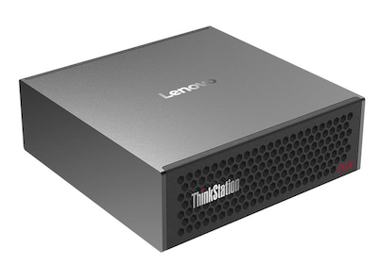
The Lenovo ThinkStation PGX, based on the NVIDIA DGX Spark™ platform, is accelerated by the NVIDIA GB10 Grace Blackwell Superchip and provides AI-ready resources in a compact footprint. Image source: Lenovo.
To handle the compute-intensive, graphics-rich applications of AI-driven workflows, end users need properly equipped and configured hardware. Workstations such as the Lenovo ThinkStation P-series workstations accelerated with NVIDIA RTX GPUs are well suited to handle multiple applications and on-premises deployment, which provides more secure data management and faster responses with inference and model fine-tuning.
A Practical 90-day Agentic AI Starting Framework |
|
Part 1 (Days 1–30): Build the Local AI Foundation
Part 2 (Days 31–60): Launch Pilot Workflows
Part 3 (Days 61–90): Scale Successful Workflows
|
Numerous Lenovo and NVIDIA configurations are ISV-certified, providing end users confidence that systems will more than meet industry-specific demands. With Lenovo workstations providing scalable platforms for local AI deployment and NVIDIA RTX technology accelerating computationally intensive workflows, these configurations have proven capable in supporting AI-enhanced workflows.
For example, Lenovo P7/P8 desktop workstations powered by NVIDIA RTX GPUs provide the computing foundation needed to support agentic AI and other emerging workflows. These workstations are also equipped with high-endurance storage drives for rapid data access and up to 2TB of memory, allowing AEC professionals to work with large datasets smoothly.
The Lenovo ThinkStation PGX, based on the NVIDIA DGX Spark™ platform, is the first Lenovo workstation accelerated by the NVIDIA GB10 Grace Blackwell Superchip and is designed specifically for AI development, running on Linux OS. With a compact footprint, it supports LLM, inference, and AI-development workflows, complementing RTX workstation environments used for day-to-day design and engineering applications. The local AI environments can support large-model processing, simulation workflows, and AI-assisted applications directly alongside project data and design environments.
For AEC professionals requiring mobility, Lenovo’s ThinkPad P-series mobile workstations offer powerful configurations tailored for handling AI-enabled workflows remotely. These portable solutions integrate high-performance NVIDIA RTX GPUs and the latest Intel or AMD processors, enabling engineers and designers to handle complex AI-driven modeling and simulations while on the go.
For firms not yet ready to fully use AI across enterprise infrastructure, but ready to implement localized AI workflows, AI-capable workstations are still key to successful AI deployment in design and engineering environments. These workstations can deliver superior performance of graphics-rich design workflows and provide the foundation for expansion of AI-aided workflows in the future.
Preparing the Next Generation of AI-Driven AEC Workflows
As AEC firms seek more efficient workflows with sustainable operational approaches, AI offers significant opportunities to improve project delivery and decision-making. In addition to accelerating individual tasks, AI can help connect multiple models and tools, using agentic workflows to support more thorough, accelerated analysis and design.
The shift from AI assistance to workflow execution requires placing the right hardware resources in the right environment. As AI-enabled workflows continue evolving, firms that successfully integrate local AI capabilities into everyday design and engineering operations may be better positioned to improve project performance, accelerate project delivery, and adapt to increasingly complex project demands.
The longer-term opportunity extends beyond individual productivity gains. As agentic AI matures, AEC firms will increasingly move from isolated AI tools toward connected, orchestrated workflows that coordinate applications and automate repetitive processes, allowing teams to focus more of their time on successful project outcomes.
Frequently Asked QuestionsWhat is agentic AI?Agentic AI refers to AI systems that can plan, make decisions, and execute tasks across multiple applications with limited human intervention. Unlike traditional AI assistants that respond to prompts, agentic AI can coordinate workflows and automate multi-step processes. How is agentic AI different from generative AI?Generative AI creates content such as text, images, code, and summaries. Agentic AI builds on generative AI by taking actions, using tools, accessing data sources, and coordinating tasks to achieve broader goals. What is Model Context Protocol (MCP)?Model Context Protocol (MCP) is an open standard that helps AI systems connect with software applications, APIs, databases, and external tools. It acts as a common communication layer that enables AI agents to work across multiple systems. Why are AI-ready workstations important for AEC firms?AI-ready workstations provide the processing power, memory, graphics performance, and local AI capabilities needed to support AI-assisted design, simulation, visualization, digital twins, and agentic workflows while maintaining control over project data. What role do local AI environments play in engineering workflows?Local AI environments allow organizations to run AI models, inference, and workflow automation on-premises. This approach can improve performance, reduce latency, strengthen data governance, and help protect intellectual property. How can AEC firms begin implementing AI?Many firms start by identifying workflow bottlenecks, deploying AI-capable workstations, testing pilot use cases, and developing governance policies. Successful pilots can then be expanded into broader AI-enabled workflows and long-term digital transformation initiatives. |
This article was sponsored by Lenovo and NVIDIA.

↓↓↓Download the PDF ↓↓↓

***





Searching for more information about Architecture, Infrastructure, and Construction?
Click here!